

Emergency Responder Communication Enhancement Systems (ERCES) are critical life-safety systems that ensure first responders can communicate reliably inside buildings during emergencies. Whether it’s a fire, natural disaster, or infrastructure outage, ERCES must stay operational when it matters most. Backup power solutions, including batteries and generators, play a pivotal role in ensuring an ERCES remains functional during power losses.
But with evolving code requirements, diverse system configurations, and varying site conditions, choosing the right backup power strategy is far from straightforward. We help you compare battery systems vs. generator solutions for ERCES applications, explore regulatory requirements (including 12-hour vs. 24-hour needs), examine cost and maintenance implications, and provide a practical approach to designing reliable backup power for life-safety communication systems.
Why Backup Power Matters for ERCES
Emergency situations rarely happen under ideal conditions. Fires, severe weather events, earthquakes, flooding, and utility failures often occur at the same time, or trigger one another. When normal building power is lost, most systems shut down immediately. For emergency responders, however, this is exactly when communication must remain fully operational.
ERCES is designed to support first responders during the most critical moments of an incident. But without reliable backup power, the system cannot function. If ERCES loses power during an emergency, radio signals weaken or disappear entirely, creating communication dead zones inside the building. Responders may struggle to coordinate operations, relay situational updates, or call for assistance, increasing risk to both occupants and emergency personnel.
The consequences of ERCES power loss extend beyond inconvenience. Delayed communication can slow evacuations, complicate rescue efforts, and reduce overall response effectiveness at a time when seconds matter. In complex buildings, especially those with basements, stairwells, or shielded areas, the absence of backup power can make large portions of the structure inaccessible from a communications standpoint.
To prevent these scenarios, building and fire codes require ERCES to be supported by dedicated standby power. Backup power systems must be capable of keeping ERCES operating at full capacity during outages, ensuring uninterrupted communication until normal power is restored or the emergency is resolved. This requirement reinforces the role of ERCES as a true life-safety system: one that must perform reliably when everything else around it is under stress.
To prevent these outcomes, model codes and standards require dedicated standby power capable of sustaining ERCES at full capacity during outages.
Regulatory Framework for ERCES Backup Power
-
International Fire Code (IFC) Requirements
The International Fire Code (IFC) mandates that in-building emergency responder communication enhancement systems include provisions for standby power.
According to the 2021 and later editions of IFC Section 510, ERCES installations must have:
- Dedicated standby batteries or
- Batteries with a connection to the facility’s emergency generator system
- Capability to operate the system at 100% capacity during outages
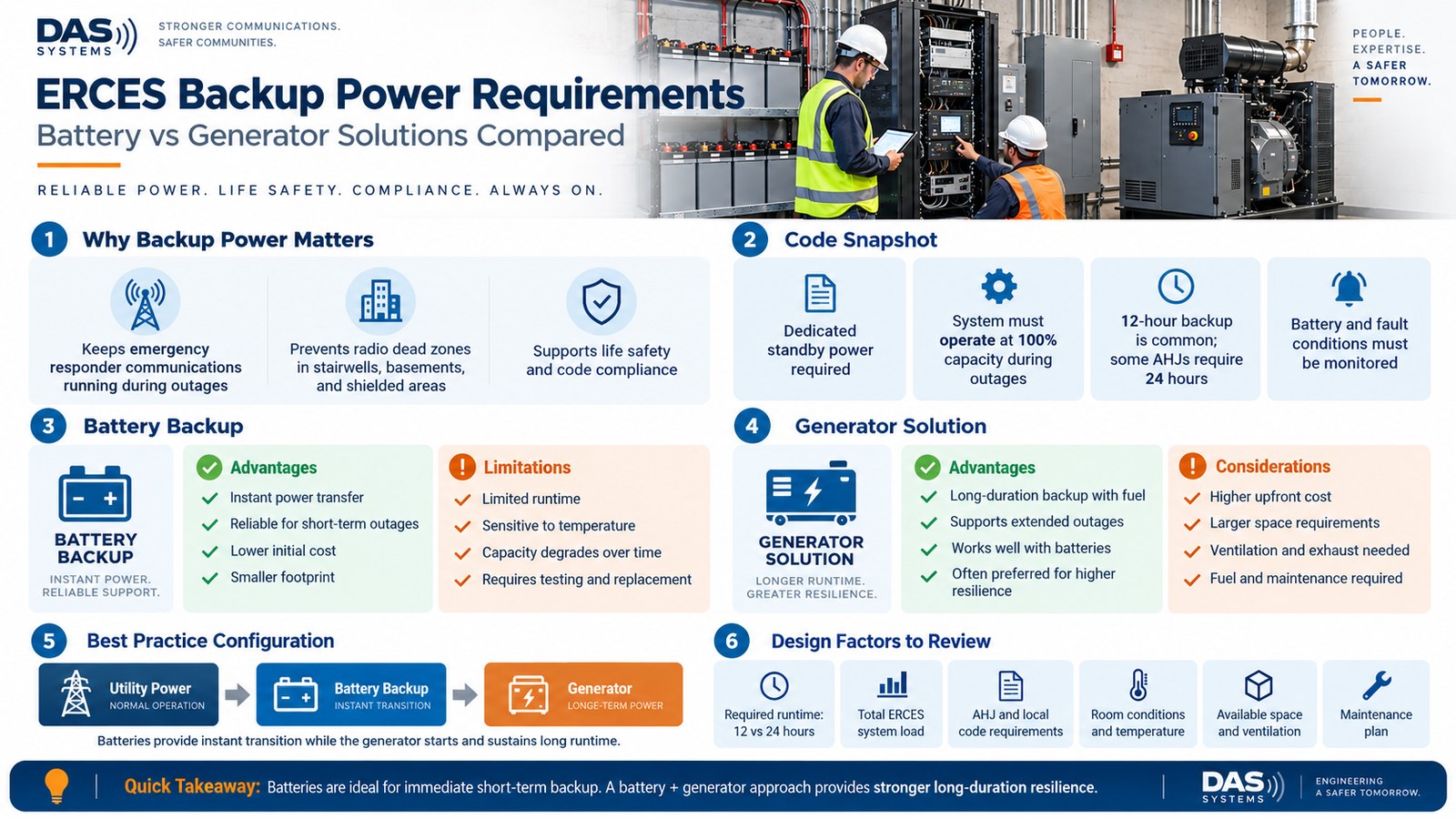
- Power for not less than 12 hours (some AHJs require 24 hours)
According to the 2021 and later editions of IFC Section 510, ERCES installations must include dedicated standby power capable of sustaining full system operation during outages, with specific expectations around duration, supervision, and survivability that are enforced during plan review and acceptance testing.
-
NFPA Power Resilience Expectations
NFPA standards such as NFPA 1221 and NFPA 72 emphasize backup power in the context of performance and survivability. While codes are sometimes interpreted differently by local jurisdictions, many AHJs enforce 24-hour backup expectations for ERCES systems based on either code adoption or local amendments.
NFPA also stresses:
- Monitoring of battery systems
- Integration with supervisory signaling
- Long-term reliability over multiple outage events
-
AHJ Variability and Local Requirements
Authorities Having Jurisdiction (AHJs) may adopt stricter backup power requirements. Some require:
- Extended generator runtime
- Battery minimums beyond 12 hours
- Redundant power feeds
- Emergency power connection verification
Battery Backup Solutions: Pros, Cons, and Best Practices
Battery systems are the first layer of backup power for ERCES. They provide immediate, uninterrupted power when utility service is lost.
Battery backup typically involves:
- A battery bank sized for the load
- A battery charger/rectifier tied to normal power
- Optional uninterruptible power supply (UPS) capability
- Alarm and supervisory contacts tied into the fire alarm system
Battery systems instantly take over when utility power fails, ensuring zero interruption to critical components such as Bi-Directional Amplifiers (BDAs), remote signal boosters, monitoring controllers, and supervisory systems.
12-Hour vs 24-Hour Battery Requirements
Depending on code adoption and AHJ enforcement:
- 12-hour battery backup remains common in jurisdictions that follow traditional IFC/NFPA minimums.
- 24-hour battery backup is increasingly required, particularly where IFC and NFPA expectations are interpreted or amended for higher resilience.
Battery capacity is calculated based on:
- Total system load (amps at specific voltages)
- Expected discharge profile
- Temperature derating
- Aging and health factors
Systems often use lead-acid or lithium-ion battery technologies, each with distinct performance and maintenance characteristics.
Advantages of Battery Backup
- Instantaneous Power Transfer
Battery backup engages instantly. It is critical for ERCES systems, where even milliseconds of downtime are unacceptable. - Reliable for Short-Term Outages
For outages lasting a few hours or during power blips, battery systems alone can sustain full operation. - Lower Initial Oversight
Compared to generators, battery systems have fewer moving parts, require no fuel, and produce no emissions. - Easier to Integrate
Batteries can be placed within utility and equipment rooms with minimal physical footprint when planned early.
Limitations of Battery Backup
- Runtime Constraints
Batteries are limited by capacity. A 24-hour requirement necessitates larger banks, greater space, and higher cost. - Temperature Sensitivity
Batteries degrade faster in high heat and must be housed in appropriate environmental conditions. - Aging and Degradation
Batteries lose capacity over time and must be tested and replaced periodically as part of maintenance.
Best Practices for Battery Backup Design
Designing battery backup for an ERCES system requires more than simply meeting a minimum runtime number. Because ERCES is a life-safety system, batteries must be engineered to perform reliably under worst-case conditions.
The first priority is proper battery sizing. Battery capacity should be calculated based on the system’s maximum operational load, not average usage. This includes all BDAs, remote amplifiers, monitoring equipment, and control components operating at full power. Designers should also factor in code-mandated runtime requirements, AHJ expectations, and performance degradation over time. Undersized batteries are a common cause of failed acceptance testing and post-occupancy issues.
Environmental control is equally important. Batteries degrade faster when exposed to high temperatures, humidity, or poor ventilation: conditions that are common in electrical or equipment rooms if not properly planned. Using temperature-controlled enclosures or dedicated battery rooms helps extend battery life and ensures consistent performance throughout the system’s service cycle.
ERCES battery systems must also be fully supervised and monitored. Codes require that loss of normal power, low battery voltage, charger failure, and other fault conditions be reported to the building’s fire alarm system. Integrating battery supervision with the fire alarm panel allows issues to be identified early, before a system fails during an emergency.
Regular maintenance is essential to long-term reliability. Annual battery capacity testing should be part of every ERCES maintenance program, along with visual inspections and charger verification. Over time, batteries lose capacity even if they appear functional, making routine testing critical for compliance and performance.
Finally, designers must account for voltage drop and cabling losses between the battery source and ERCES equipment. Long cable runs, undersized conductors, or poor connections can reduce effective runtime and lead to unexpected shutdowns. Proper electrical design ensures that batteries deliver usable power for the full required duration.
Generator Solutions: Extended Backup for ERCES
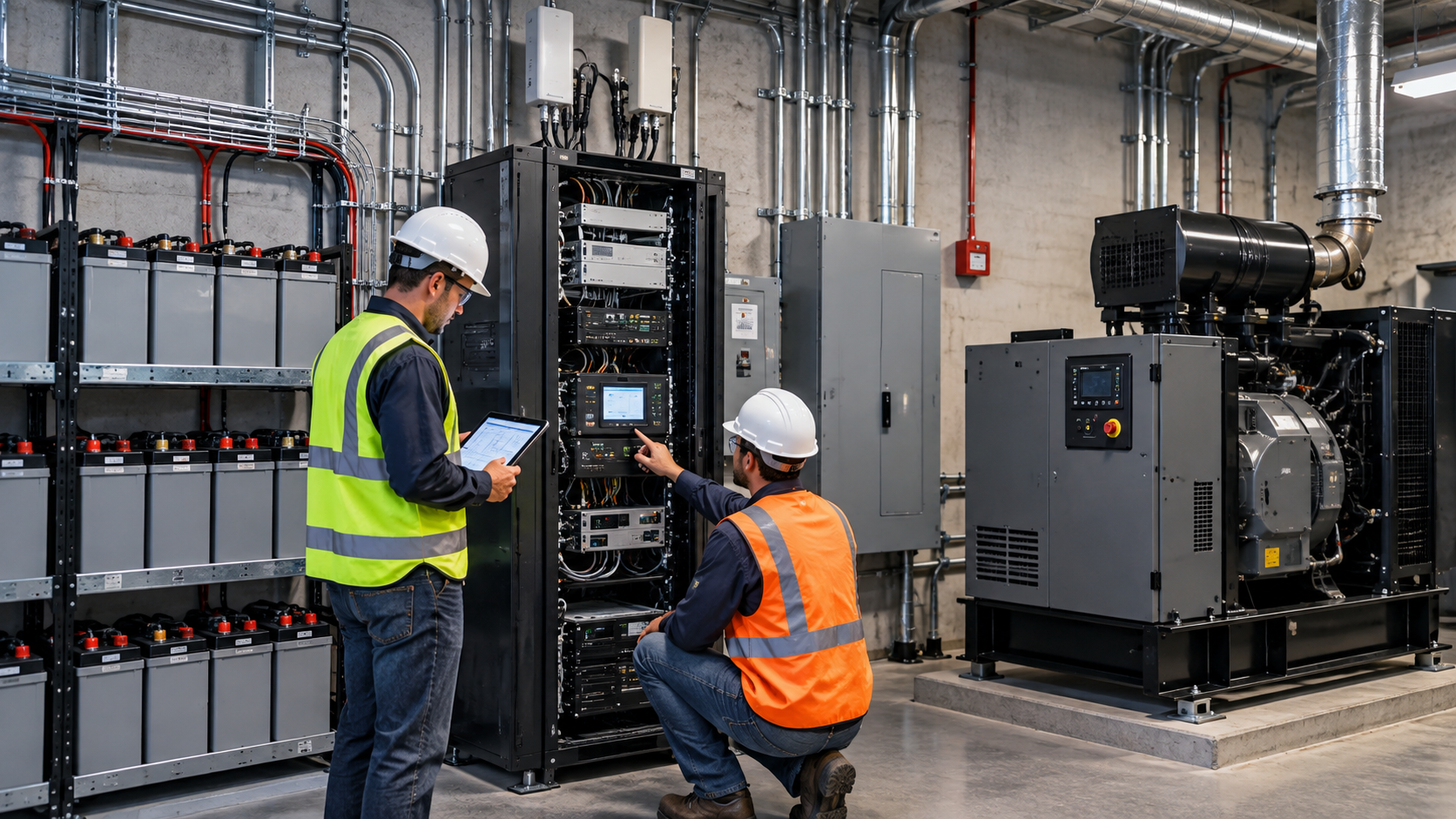
While batteries provide instant backup, they are fundamentally limited in duration. Generators extend runtime indefinitely (as long as fuel and maintenance are managed) and are often used in conjunction with batteries.
How Generator Backup Works
A generator can be:
- Diesel powered (most common for extended outages)
- Natural gas or propane (often used for continuous or automatic startup)
A typical configuration connects the ERCES system to:
- Normal building power (utility)
- Battery backup for instant transition
- Generator for sustained operation
The generator kicks in minutes after an outage, while the battery covers the transition flight, ensuring no system interruption. Batteries handle the initial seconds or minutes, and the generator then sustains ongoing operations for many hours.
Generator Advantages
- Unlimited Runtime
Generators can operate for days if fuel is available, making them ideal for long outages. - Complements Battery Systems
Paired with batteries, generators offer the best of both worlds: instant transition and sustained power. - Meets Stricter AHJ Expectations
Some AHJs interpret backup requirements to mean combined batteries and generator solutions, particularly for systems requiring 24 hours or more of resilience.
Generator Considerations and Challenges
- Higher Initial Cost
Generators require substantial capital for equipment, fuel storage, transfer switches, and installation. - Space and Ventilation Requirements
They need significant space, proper ventilation, and compliance with exhaust and noise regulations. - Fuel Logistics
Diesel generators require fuel storage tanks, maintenance of fresh fuel, and strategies for long-term outages. - Operational Testing
Generators must be tested regularly to ensure readiness, including load bank testing and transfer switch inspections. (dassystems.com maintenance resources)
Battery vs Generator: Head-to-Head Comparison
| Feature | Battery Backup | Generator Solution |
| Instant Power Transition | ✔️ Yes | ❌ Requires seconds to minutes (covered by batteries) |
| Runtime Duration | Limited (12–24 hours) | Near-continuous with fuel |
| Maintenance Requirements | Moderate (testing, replacement) | High (mechanical service, fuel management) |
| Initial Cost | Lower | Higher |
| Space Footprint | Smaller | Larger |
| Environmental Constraints | Sensitive to temperature | Requires ventilation, exhaust management |
| AHJ Acceptance | Meets minimum codes | Preferred for extended outages |
Cost Implications of Backup Power Strategies
Backup power can be a significant portion of an ERCES project budget. Costs vary based on:
- Required runtime (12 vs 24 hours)
- Battery type and bank capacity
- Generator size and fuel strategy
- Environmental site conditions
- Local code interpretations
Battery-only systems tend to be less expensive initially, but larger battery banks for 24-hour runtime drive up cost and space requirements.
Generator installations incur higher upfront costs due to:
- Equipment purchase (engine, transfer switch)
- Fuel storage tanks and safety compliance
- Permitting and mechanical work
- Annual maintenance contracts
However, generators reduce long-term risk by offering extended backup and are often preferred for critical venues such as hospitals, campuses, and data centers. Backup power requirements often represent a meaningful portion of an ERCES budget, particularly when extended battery runtimes or generator integration are required. Costs vary significantly based on system design, runtime expectations, and building complexity.
Maintenance and Testing Requirements
Backup power systems are subject to code-mandated testing and ongoing maintenance. Both batteries and generators must be included in annual inspections and monitored for health and performance.
Key maintenance elements include:
- Battery capacity and voltage testing
- Generator load tests
- Transfer switch functional checks
- Alarm and supervision verification via fire alarm systems (loss of AC power, low battery, etc.)
- Regular documentation for AHJ compliance
Annual testing is required to verify that backup power systems activate properly during outages and continue to support ERCES operation for the full required duration, including battery discharge and generator transfer performance.
Designing Backup Power for Real-World Projects
When designing ERCES backup power, start early in the project with:
- AHJ coordination to confirm runtime expectations (12 vs 24 hours)
- Load analysis to size batteries and generators correctly
- Space planning for battery rooms and generator placements
- Environmental analysis to mitigate heat, vibration, or enclosure needs
- Integration with alarm systems for supervisory signaling
Conclusion
Backup power is foundational to system performance, compliance, and life-safety effectiveness. Whether through strategically sized battery systems, generator integrations, or a combination of both, a properly engineered backup solution ensures that emergency responders can maintain critical communication during prolonged outages.
Understanding the differences between battery and generator solutions, and how codes like IFC and NFPA influence power requirements (including 12- vs 24-hour needs), enables better decision-making and smoother project delivery.
When backup power is thoughtfully integrated, regularly tested, and professionally maintained, ERCES becomes a resilient system that stands ready when first responders need it most, protecting lives, property, and compliance peace of mind.