
Choosing the wrong contractor for an Emergency Responder Radio Communication System (ERRCS) can cost a building owner months of delay, a failed inspection, or worse, a system that fails when firefighters need reliable communications.
ERRCS system vendor selection is not a decision to rush. It can determine whether your building passes Authority Having Jurisdiction (AHJ) review on the first attempt, receives its Certificate of Occupancy on schedule, and provides dependable radio coverage for first responders throughout the building during an emergency.
The sections below outline what to look for when evaluating an ERRCS/ERCES vendor, the qualifications that distinguish experienced system integrators, and the questions to ask before awarding the contract.
Why Vendor Selection Matters More than It Seems
ERRCS, also known as ERCES (Emergency Responder Communication Enhancement Systems), is a life-safety system. It is not a conventional low-voltage installation where a missed detail simply affects network performance. A poorly designed or improperly installed system can fail an AHJ inspection outright or, more concerning, leave first responders without reliable radio communications during an emergency.
Code requirements set a high bar. Under NFPA 1225, critical areas such as stairwells, fire command centers, and elevator lobbies must maintain a minimum signal level of -95 dBm or better. Broader coverage requirements typically call for 99% coverage in critical areas and 95% coverage in general areas. Meeting those performance thresholds requires accurate radio frequency (RF) modeling, appropriate equipment selection, and a contractor who understands how the local AHJ applies adopted codes during plan review and acceptance testing.
Vendor selection is often the point where inspection outcomes, project schedules, and long-term system performance are either protected or put at risk.
From “Why Vendor Selection Matters More than It Seems,” above
A vendor that underbids the project by skipping a proper RF survey or installing uncertified components to reduce costs increases the risk of a failed acceptance test, an expensive retrofit, or delayed occupancy.
Understanding the ERRCS Vendor Landscape
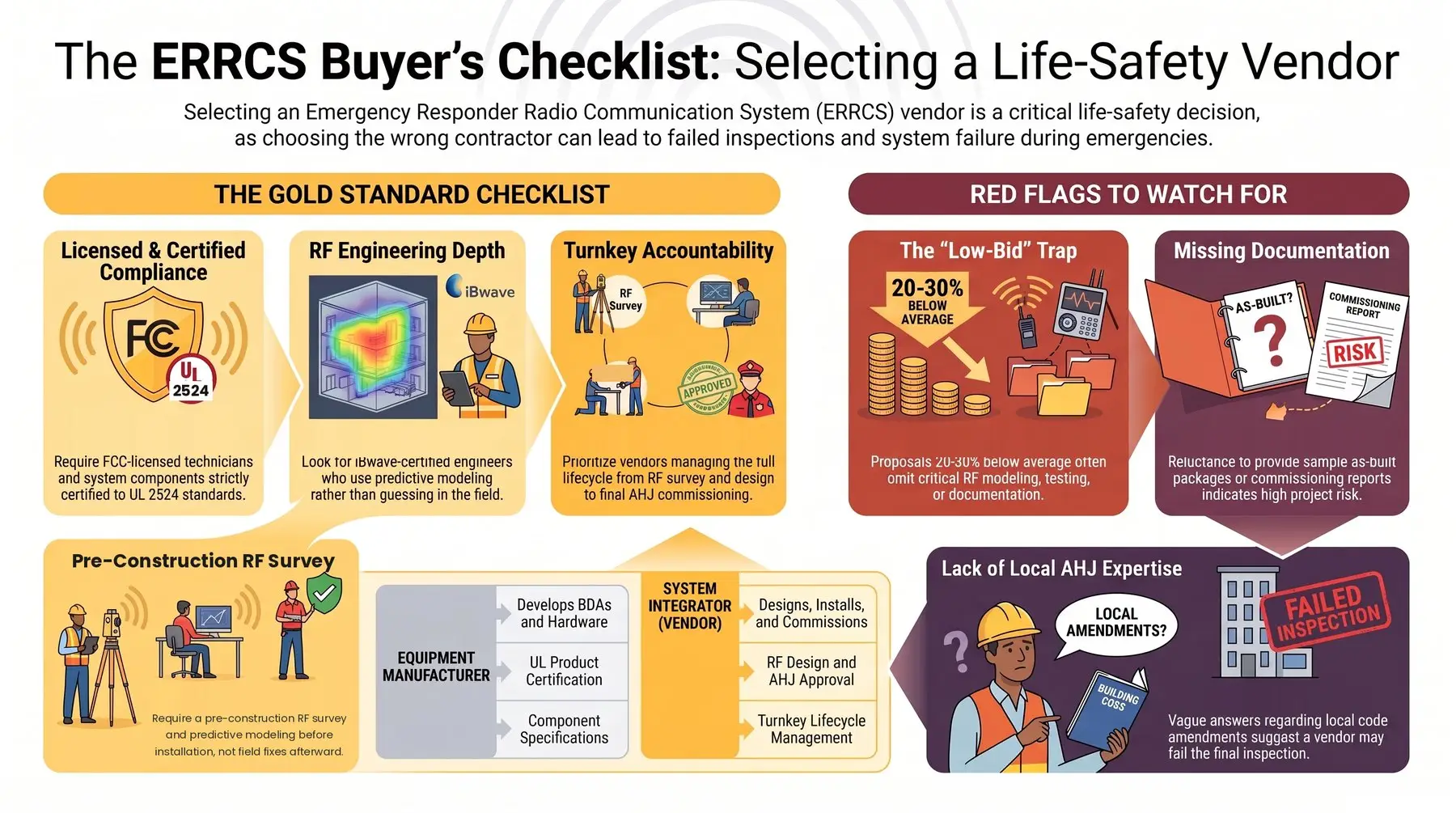
Before comparing proposals, it helps to understand who you’re evaluating. The ERRCS/ERCES market consists of two distinct types of companies, and confusing their roles is a common mistake during vendor selection.
Equipment Manufacturers
What they do:
- Develop BDAs, DAS hardware, and backup power components
- Certify their products to UL 2524
- Publish technical specifications
Most do not design, install, commission, or maintain systems for building owners.
Installation & Integration Vendors
Also called system integrators or ERRCS contractors. These are the companies most building owners hire:
- Select suitable equipment
- Develop the RF design
- Coordinate permitting
- Install the system
- Manage AHJ submissions through commissioning
Some operate nationwide, while others specialize in specific regions or jurisdictions.
This distinction matters because a manufacturer’s product certification does not reflect the quality of an individual contractor’s RF design, installation, or commissioning practices. Two buildings using the same UL 2524-listed equipment can achieve very different inspection outcomes depending on the engineering, installation quality, and testing performed. Vendor selection should focus on the system integrator’s experience and project record, not simply the equipment brand specified.
Core Criteria for ERRCS/ERCES Vendor Selection
Four regulatory pillars sit underneath every credible ERRCS proposal. A vendor who cannot speak clearly to all four is not ready for your project.
IFC SECTION 510
International Fire Code
- Establishes in-building coverage requirements
- Amended locally by the AHJ
An approach accepted in one municipality may require revisions in another.
NFPA 1225
Emergency Services Communications
- Minimum -95 dBm in critical areas
- 99% critical / 95% general coverage
- Cross-references NFPA 72 for fault supervision
Also governs backup power and pathway survivability.
UL 2524 & FCC PART 90
Equipment and Licensing
- All major components UL 2524 listed
- Class B boosters registered with the FCC
- Consent of the FCC licensee required
Neither is optional under current code editions.
1. FCC Licensing and Technician Qualifications
ERRCS systems retransmit public safety radio frequencies, making them subject to FCC Part 90 rules governing Private Land Mobile Radio (PLMR) services. Class B signal booster systems must be registered with the FCC, and operation requires the consent of the FCC licensee whose frequencies are being amplified. A qualified vendor should have FCC-licensed technicians who can clearly explain how they manage frequency coordination, registration, and ongoing compliance, not just equipment installation.
2. UL 2524-Listed Equipment
UL 2524 is the certification standard for in-building emergency responder communication enhancement system components, including BDAs, DAS equipment, and backup power systems. Current editions of the IFC, NFPA 1, and NFPA 1225 require UL 2524-listed equipment. If a vendor cannot verify that every major system component is UL 2524 listed, the installation may not satisfy applicable inspection requirements, regardless of workmanship.
3. RF Engineering Depth, Not Just Installation Capability
Installing hardware is only one phase of an ERRCS project. The greater challenge is designing a system that accounts for building materials, structural attenuation, and future radio network changes. Look for vendors with certified RF engineers, ideally with iBwave design certification, who perform predictive modeling before construction rather than relying on field adjustments after installation.
Ask how the vendor approaches Delivered Audio Quality (DAQ) testing as well as signal-strength measurements. DAQ testing evaluates the intelligibility of transmitted emergency communications, and a qualified vendor should be able to explain how the system achieves the required DAQ performance during acceptance testing. Identifying coverage gaps early helps reduce redesigns, change orders, and delays during acceptance testing.
4. Local Code and AHJ Experience
ERRCS requirements are shaped by IFC Section 510, NFPA 1225, and local amendments adopted by the Authority Having Jurisdiction (AHJ). Because enforcement and adopted code provisions vary by jurisdiction, an approach accepted in one municipality may require revisions in another. Vendors with experience across multiple jurisdictions understand local documentation expectations, plan review processes, and how to minimize delays during permitting and final acceptance.
NFPA 1225 also cross-references NFPA 72 for fault supervision. For systems with remote monitoring capabilities, the applicable cybersecurity requirements are addressed through the 2025 edition of NFPA 72 rather than being presented as a cybersecurity requirement introduced directly by NFPA 1225.
Vendors should understand how these requirements interact so a system designed to meet RF coverage objectives also satisfies applicable supervision and monitoring expectations adopted by the AHJ.
5. Turnkey Capability: Design Through Commissioning
When design, permitting, installation, and testing are divided among multiple parties, accountability can become fragmented. One of the strongest vendor selection criteria is whether a single company can manage the project through its entire lifecycle:
- Pre-construction RF survey and predictive modeling
- Benchmark RF grid testing and DAQ evaluation across applicable public safety frequencies
- System design and permitting, including stamped construction drawings
- Installation using UL 2524-listed equipment
- Commissioning, as-built documentation, and AHJ sign-off
- Annual recertification and ongoing maintenance
A single point of accountability helps reduce miscommunication between designers, installers, and project stakeholders, lowering the risk of coordination issues that can delay acceptance testing or require corrective work before final approval.
6. Documentation and As-Built Packages
AHJs typically require documentation throughout the project. A complete package generally includes:
ANNUNCIATION & MONITORING DOCS
STAMPED DRAWINGS
COMMISSIONING REPORT
AS-BUILT PACKAGE
A vendor who treats documentation as an afterthought increases project risk because incomplete records can complicate inspections, future maintenance, or annual recertification.
Before awarding a contract, ask to review a sample commissioning report and as-built package.
7. Backup Power and Pathway Survivability Expertise
NFPA 1225 addresses dedicated circuits, supervised secondary power, and fire-rated cabling or equivalent pathway protection to help maintain system operation during a fire.
Secondary Power
Battery backup versus generator-supported solutions carry different runtime, monitoring, and maintenance implications. Not every contractor has equal experience evaluating the tradeoff for a specific building.
Pathway Protection
Selecting the appropriate fire-rated pathway, or an approved equivalent, affects whether the system keeps operating during a fire. These decisions deserve careful discussion during vendor evaluation.
8. Recertification and Maintenance Plans
ERRCS/ERCES systems generally require periodic inspection and annual testing under applicable codes and local requirements. Missing scheduled recertification may affect ongoing compliance or create issues during inspections. Ask whether the vendor offers a structured maintenance program that includes scheduling, testing, reporting, and any documentation needed for the AHJ, or whether those responsibilities remain with the building owner.
9. Track Record and References
A vendor’s experience across multiple building types and jurisdictions is often one of the strongest indicators of capability. Request references from recent projects, and ask how those installations progressed through AHJ review and acceptance testing. Repeated inspection issues or recurring corrective work should prompt additional questions before moving forward.
10. Geographic Reach and Licensing Coverage
If your organization manages facilities across multiple states, a vendor with multi-state licensing and a geographically distributed service team can simplify project coordination and ongoing support. While this may be less important for a single-building project, it becomes a significant advantage when managing portfolios or multi-site deployments.
Evaluating Bids: Why the Lowest Price Is Rarely the Best Value
ERRCS proposals often vary significantly, and the difference is rarely just contractor markup. More commonly, it reflects meaningful differences in project scope. A lower-priced proposal may omit pre-construction RF modeling, substitute non-UL 2524 components where permitted, reduce the scope of benchmark grid testing, or exclude commissioning documentation from the contract.
When comparing proposals, ask each vendor to clearly itemize design, permitting, equipment, labor, testing, commissioning documentation, and any first-year maintenance services.
A proposal priced 20 to 30 percent below the others deserves a careful review of what has been excluded rather than an automatic award.
From “Evaluating Bids,” above
Because ERRCS is a life-safety system that can affect Certificate of Occupancy timelines, the cost of redesigns, corrective work, or delayed inspections often outweighs any initial savings.
What a Typical Project Timeline Looks Like
Understanding the typical phases of an ERRCS project makes it easier to evaluate whether a vendor’s proposed schedule is realistic.
PHASE 01
Pre-construction RF survey and predictive modeling
PHASE 02
System design and permitting, including stamped drawings
PHASE 03
Equipment procurement and installation
PHASE 04
Benchmark testing, AHJ acceptance and commissioning
Depending on the building’s size, complexity, and local review process, timelines may range from several weeks for a small commercial property to several months for a high-rise or campus environment.
Vendors should be able to explain each project phase and justify any unusually compressed schedule. If permitting, testing, or AHJ review is treated as a formality, the proposed timeline may be overly optimistic. These stages often determine the overall project schedule, particularly in jurisdictions with longer plan review or inspection queues.
Red Flags to Watch For
Certain patterns consistently warrant closer review during vendor evaluation:
- Reluctance to verify that proposed system components are UL 2524 listed
- No discussion of FCC licensing, frequency coordination, or signal booster registration
- Proposals priced well below comparable bids without a clearly defined scope
- Inability to provide sample documentation, commissioning reports, or relevant project references
- Unclear answers about the applicable codes, local amendments, or AHJ review process for your project
- No defined plan for ongoing maintenance, periodic testing, or annual recertification
None of these issues automatically disqualifies a vendor on its own, but several together should prompt a more detailed review before awarding the project.
Questions Worth Asking Before You Commit
- Are your technicians FCC licensed, and how do you manage frequency coordination and FCC Part 90 registration?
- Can you verify that every major component in the proposed system is UL 2524 listed?
- Who is responsible for the RF design, and what engineering certifications do they hold?
- How many ERRCS/ERCES projects have you completed within this AHJ or jurisdiction?
- What documentation is included in your commissioning and as-built package?
- Do you provide ongoing maintenance and annual recertification services, or are those handled separately?
- How do you perform DAQ testing, and how do you verify that the system meets the required DAQ performance during acceptance testing?
- If the system does not meet coverage requirements during acceptance testing, what is your corrective process?
Vendors who answer these questions clearly, support their responses with documentation, and explain their process in detail are generally better positioned to deliver a successful project.
Ready to Get Started?
Complete the form to request a consultation. Our team will review the information, and a personal manager will reach out to you.
New Construction vs. Retrofit Projects
Vendor experience should also be evaluated in the context of your specific project type.
New Construction
Coordinated early with the wider project team:
- General contractor and electrical contractors
- Integrated into building plans before construction progresses
- RF system designed alongside other life-safety systems
Early coordination allows the RF system to be built into the design rather than worked around later.
Retrofit Projects
Adding an ERRCS to an existing or occupied building brings different challenges:
- Working around finished interiors
- Minimizing disruption to occupants
- Routing cable through spaces never designed to support the system
Access constraints and occupant coordination drive both schedule and cost.
Some vendors have deeper experience in one project type than another. A contractor with extensive new construction experience may be less familiar with the access constraints and coordination challenges of retrofitting a fully occupied office tower or an operating hospital.
Ask about the vendor’s experience with projects similar to yours, and request references that demonstrate comparable building types and project conditions rather than relying solely on overall company history.
Where DAS Systems Fits
DAS Systems designs, installs, and maintains ERRCS/ERCES, cellular DAS, and Wi-Fi systems for commercial facilities across the United States.
Listed Equipment, Licensed Technicians
- UL 2524-listed ERRCS and BDA deployments
- Supported by FCC-licensed RF technicians
Level 3 iBwave RF Design
- Predictive modeling before installation begins
- Coverage evaluated at design stage, not in the field
Maintenance and Recertification
- Scheduling, testing, and documentation
- Supports annual recertification and AHJ requirements
Additional project examples, including fire alarm integration and below-grade coverage design, are available through the DAS Systems blog and case studies.
Frequently Asked Questions
How do I choose an ERRCS vendor?
Choose an ERRCS vendor based on technical qualifications, experience delivering code-compliant installations, and a proven record of successful projects rather than price alone. Look for a contractor with experience designing, installing, testing, and maintaining systems that comply with applicable codes and standards, including NFPA 1225, IFC Section 510, FCC Part 90 requirements, and UL 2524-listed equipment. Ask about RF engineering capabilities, AHJ experience, commissioning documentation, ongoing maintenance services, and references from projects similar to yours.
Does every building need an ERRCS?
No. Not every building is required to have an ERRCS. Requirements depend on factors such as building size, occupancy type, construction materials, and the level of existing public safety radio coverage inside the structure. Depending on local code requirements, the Authority Having Jurisdiction (AHJ) may require a radio coverage assessment, predictive RF modeling, or post-installation grid testing to determine whether an ERRCS is necessary. Buildings that do not meet the required signal strength may require an ERRCS before receiving final approval or a certificate of occupancy.
How long does an ERRCS installation take?
The timeline varies depending on the building’s size, complexity, permitting requirements, and whether the project is new construction or a retrofit. Smaller commercial buildings may be completed in several weeks, while high-rise buildings, hospitals, airports, or large campuses can take several months. An experienced ERRCS vendor should provide a realistic project schedule that includes RF design, permitting, equipment procurement, installation, testing, commissioning, and AHJ acceptance.
What certifications should an ERRCS contractor have?
A qualified ERRCS contractor should demonstrate expertise in RF engineering, code compliance, and public safety communications. Buyers should look for vendors that employ qualified RF engineering personnel, use UL 2524-listed system components, and demonstrate experience with FCC Part 90 compliance, predictive RF design, and AHJ acceptance testing. Engineering credentials such as iBwave certification, combined with a documented record of successful ERRCS installations, can further demonstrate technical expertise.
What’s the difference between an ERRCS vendor and a manufacturer?
An equipment manufacturer designs, manufactures, and certifies components such as bi-directional amplifiers (BDAs), donor and service antennas, and other system hardware. An ERRCS vendor, often called a system integrator, is responsible for designing, installing, testing, commissioning, and maintaining the complete system. While manufacturers certify their products to applicable standards, the vendor is responsible for ensuring the finished installation meets project specifications, applicable codes, and AHJ expectations.
How much does an ERRCS system cost?
ERRCS installation costs vary depending on factors such as building size, construction materials, existing radio coverage, RF design complexity, equipment requirements, and local permitting. New construction projects often have different cost considerations than retrofit installations, which may require additional labor to work around occupied spaces and existing infrastructure. An experienced ERRCS vendor can provide a detailed proposal after completing a site assessment or radio coverage evaluation.
How do I know if my building has adequate public safety radio coverage?
The most reliable way to determine whether your building has adequate public safety radio coverage is through a professional radio coverage assessment. Depending on the project stage and local requirements, this may include predictive RF modeling, an on-site signal survey, or benchmark grid testing. These evaluations identify areas with insufficient radio coverage and help determine whether an ERRCS is required to meet applicable code and AHJ requirements.
What happens if an ERRCS fails AHJ acceptance testing?
If an ERRCS does not meet the required coverage or documentation standards during AHJ acceptance testing, the vendor may need to identify the cause, modify the system design, install additional equipment, or perform corrective testing before requesting another inspection. These changes can increase project costs and delay occupancy. Choosing an experienced vendor that performs thorough RF design, predictive modeling, and quality assurance helps reduce the risk of corrective work later in the project.
Should I choose a local ERRCS contractor or a national provider?
The right choice depends on your project requirements. Local contractors may have established relationships with nearby AHJs and familiarity with regional code interpretations, while national providers often offer broader engineering resources, multi-state licensing, standardized processes, and ongoing support for organizations managing multiple facilities. Regardless of location, the most important factors are the vendor’s technical expertise, successful project history, and experience with buildings similar to yours.
Make an Informed ERRCS Vendor Selection
ERRCS system vendor selection should be based on verifiable qualifications rather than marketing claims. FCC licensing, UL 2524-listed equipment, qualified RF engineering, AHJ experience, and a documented maintenance program are among the factors that help distinguish vendors capable of delivering compliant, well-documented installations. Because ERRCS is a life-safety system, the lowest-priced proposal is not always the best long-term value.
Building owners who ask detailed questions early in the procurement process and request supporting documentation, rather than relying solely on verbal assurances, are generally better positioned for a smoother review and acceptance process.
Ready to evaluate your building’s ERRCS/ERCES requirements? Contact DAS Systems to discuss system design, installation, testing, maintenance, or recertification with an experienced RF engineering team.