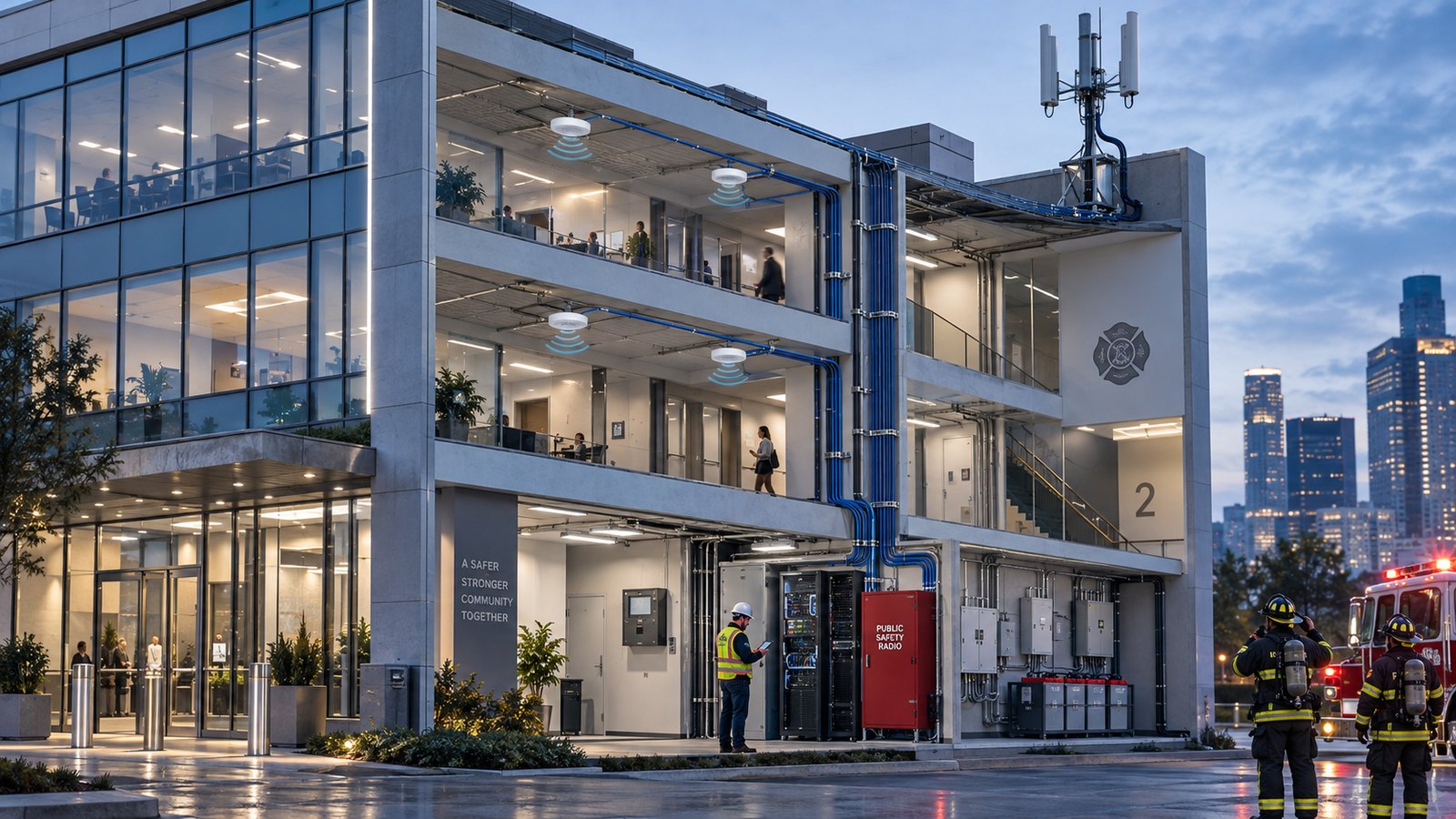


A building may meet its construction requirements yet encounter emergency responder radio coverage deficiencies during testing before occupancy. An ERCES (Emergency Responder Communication Enhancement System) requires coordinated planning, design, installation, testing, documentation, and ongoing maintenance to satisfy local Authority Having Jurisdiction (AHJ) requirements.
You may also see ERCES referred to as ERRCS (Emergency Responder Radio Communication System), an older term still used in some jurisdictions and project documentation. This ERCES compliance checklist provides a practical way to track key requirements from initial planning through testing, documentation, and ongoing maintenance.
Who Should Use an ERCES Compliance Checklist?
An ERCES compliance checklist helps project teams track key requirements from planning and RF design through installation, acceptance testing, documentation, and ongoing maintenance. It can be used by:
Who the Checklist Is For
- Building owners and developers
- Architects and general contractors
- Electrical contractors
- Fire protection engineers
- Facility and property managers
What To Use It For
- Identify requirements early
- Coordinate with the AHJ
- Track documentation and testing through each project phase
Why Building Materials Matter for ERCES Coverage
Building materials can affect in-building radio coverage. Low-E glass, reinforced concrete, steel framing, and metal decking can attenuate radio signals and contribute to coverage deficiencies. NIST testing has documented measurable signal attenuation through reinforced concrete, masonry, and glass.
Codes and Standards That Influence ERCES Compliance
ERCES compliance is governed primarily by NFPA 1225 and IFC Section 510, with requirements enforced and interpreted by the local Authority Having Jurisdiction (AHJ). Local amendments may establish additional requirements for design, testing, documentation, backup power, and system approval.
For a detailed explanation of ERCES requirements and enforcement, see our ERCES requirements and compliance guide.
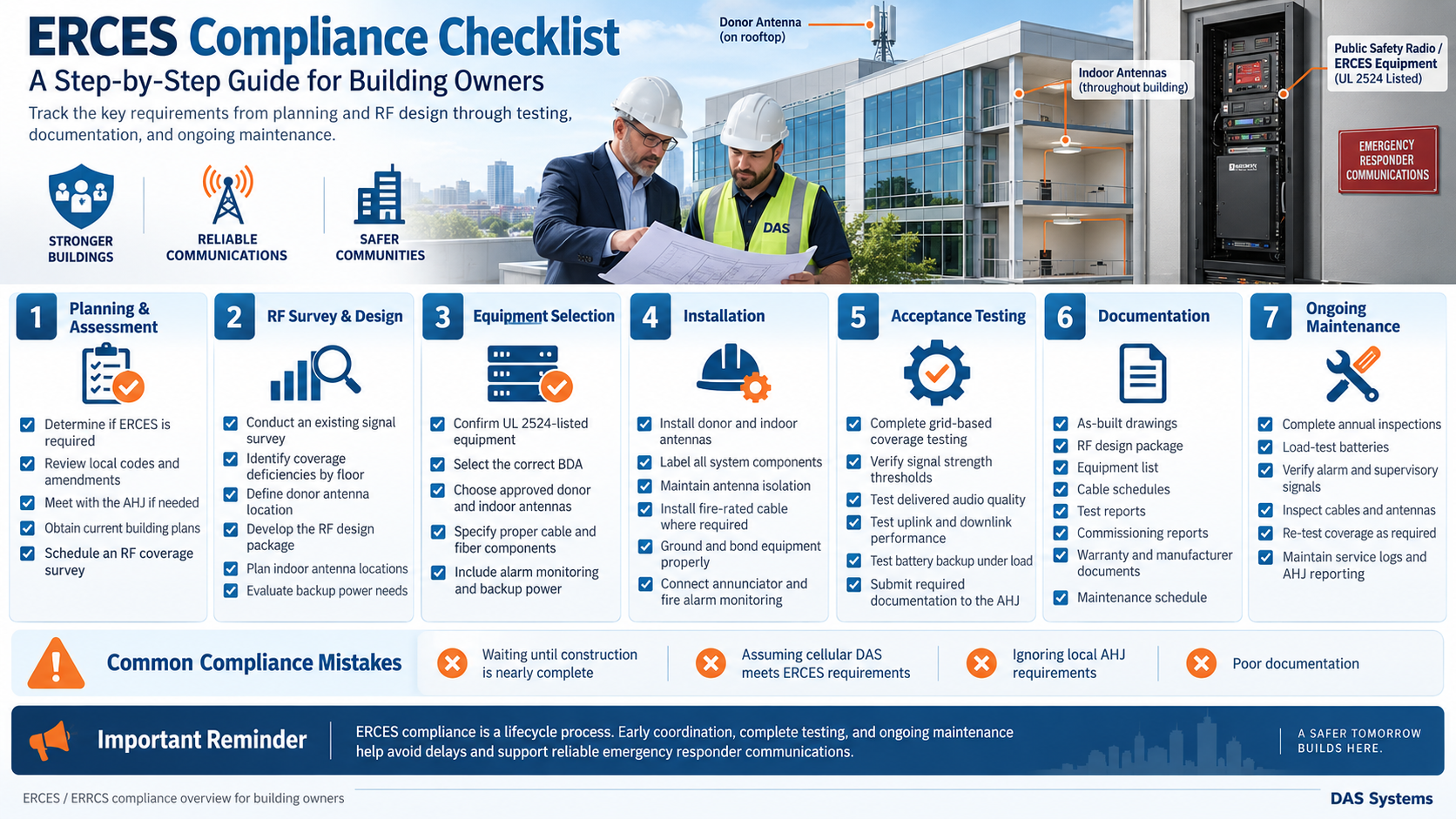
ERCES Compliance Checklist
Use this checklist to track your ERCES project from planning and RF design through installation, acceptance testing, documentation, and ongoing maintenance. Requirements can vary by jurisdiction, so confirm applicable procedures and documentation with the local AHJ before beginning work or scheduling testing.
Planning & Assessment
- Determine whether ERCES is required for the building
- Review adopted local codes and amendments
- Meet with the AHJ if required
- Identify the radio system owner and public safety frequencies involved
- Obtain current building plans
- Schedule an RF coverage survey
RF Survey & Design
Where applicable to the governing requirements, confirm that backup power provides 12 hours of operational power and 24 hours of supervisory power.
- Conduct an existing signal survey
- Identify coverage deficiencies by floor
- Define donor antenna location
- Develop the RF design package
- Size the bi-directional amplifier (BDA) correctly
- Plan indoor antenna locations
- Verify cable pathways and fire-rating needs
- Evaluate battery backup capacity
- Review grounding requirements
Equipment Selection
- Confirm all equipment is UL 2524-listed for public safety use
- Select a compatible, correctly sized BDA
- Choose an approved donor antenna
- Select indoor antennas suited to the coverage plan
- Specify coaxial cable rated for the application
- Include fiber components where applicable
- Confirm battery backup meets the applicable code-required runtime
- Confirm backup power requirements, including operational and supervisory runtime, where applicable
- Include alarm monitoring components
- Use a NEMA-rated enclosure where required
Installation
Cable identification and administration should follow applicable TIA-606 requirements, while bonding and grounding should follow applicable TIA-607 requirements. Donor and indoor antennas should also maintain adequate isolation to help prevent oscillation and feedback.
- Install the donor antenna
- Install indoor antennas per the RF design
- Label all system components per a documented identification scheme
- Maintain required isolation between donor and indoor antennas
- Install fire-rated cable where required by the applicable code
- Ground and bond equipment in accordance with applicable grounding standards
- Verify cable routing matches the design package
- Install the annunciator panel
- Connect remote alarms to the fire alarm control panel
Acceptance Testing
Follow AHJ-specific testing procedures because coverage criteria, testing methods, and documentation requirements may vary by jurisdiction.
- Complete grid-based coverage testing
- Verify signal strength meets minimum thresholds
- Test delivered audio quality
- Test uplink performance
- Test downlink performance
- Test battery backup under load
- Complete alarm and supervisory signal testing
- Submit all required documentation to the AHJ
Documentation
- As-built drawings
- RF design package
- Complete equipment list
- Cable schedules
- Test reports
- Commissioning reports
- Warranty documents
- Maintenance schedule
- Manufacturer documentation
Ongoing Maintenance
Testing frequency, battery testing procedures, and reporting requirements can vary by jurisdiction. Confirm the applicable requirements with the AHJ before scheduling annual inspections. Where the applicable ERCES requirements specify 12 hours of operational power and 24 hours of supervisory power, verify that the system meets those requirements during testing.
- Complete annual inspection
- Inspect and load-test batteries
- Verify alarm and supervisory signals
- Inspect cables
- Inspect antennas
- Re-test radio coverage as required
- Document repairs
- Maintain service logs
- Complete AHJ reporting, where required
Common ERCES Compliance Mistakes
Waiting Until Construction Is Nearly Complete
Retrofitting antennas, cabling, and a BDA after construction is substantially more disruptive than coordinating ERCES during design. Confirm RF requirements, pathways, equipment locations, and related infrastructure early.
Assuming Cellular DAS Meets ERCES Requirements
A commercial cellular DAS and an ERCES serve different purposes and operate under different regulatory requirements. A cellular DAS generally cannot substitute for a dedicated ERCES. See ERCES vs. DAS for a detailed comparison.
Ignoring Local AHJ Requirements
Model codes do not tell the entire story. Local amendments may affect coverage thresholds, testing procedures, technician qualifications, and documentation. Confirm requirements with the AHJ before design and acceptance testing.
Poor Documentation
Incomplete as-built drawings, commissioning reports, test results, or maintenance records can delay approvals and create problems during later inspections or system modifications.
Skipping Annual Testing
ERCES compliance continues after commissioning. Follow applicable inspection and testing requirements to identify battery, equipment, alarm, and coverage issues before they affect system performance.
Ready to Get Started?
Complete the form to request a consultation. Our team will review the information, and a personal manager will reach out to you.
Download a Printable ERCES Compliance Checklist
Want a version you can print, share with your project team, or use during inspections?
Contact DAS Systems to request the downloadable ERCES compliance checklist and keep your project requirements, testing, documentation, and maintenance activities organized from planning through ongoing compliance.