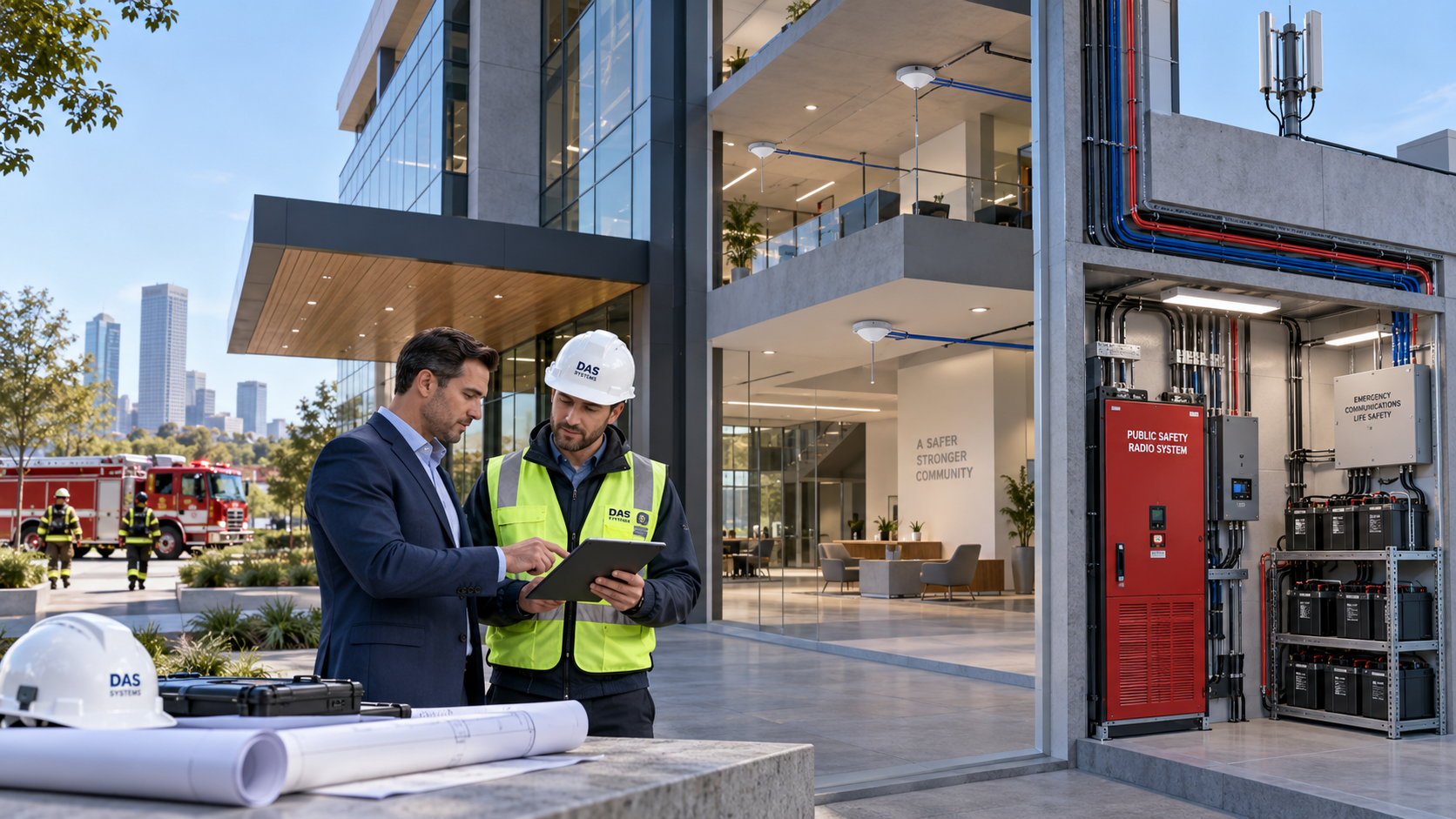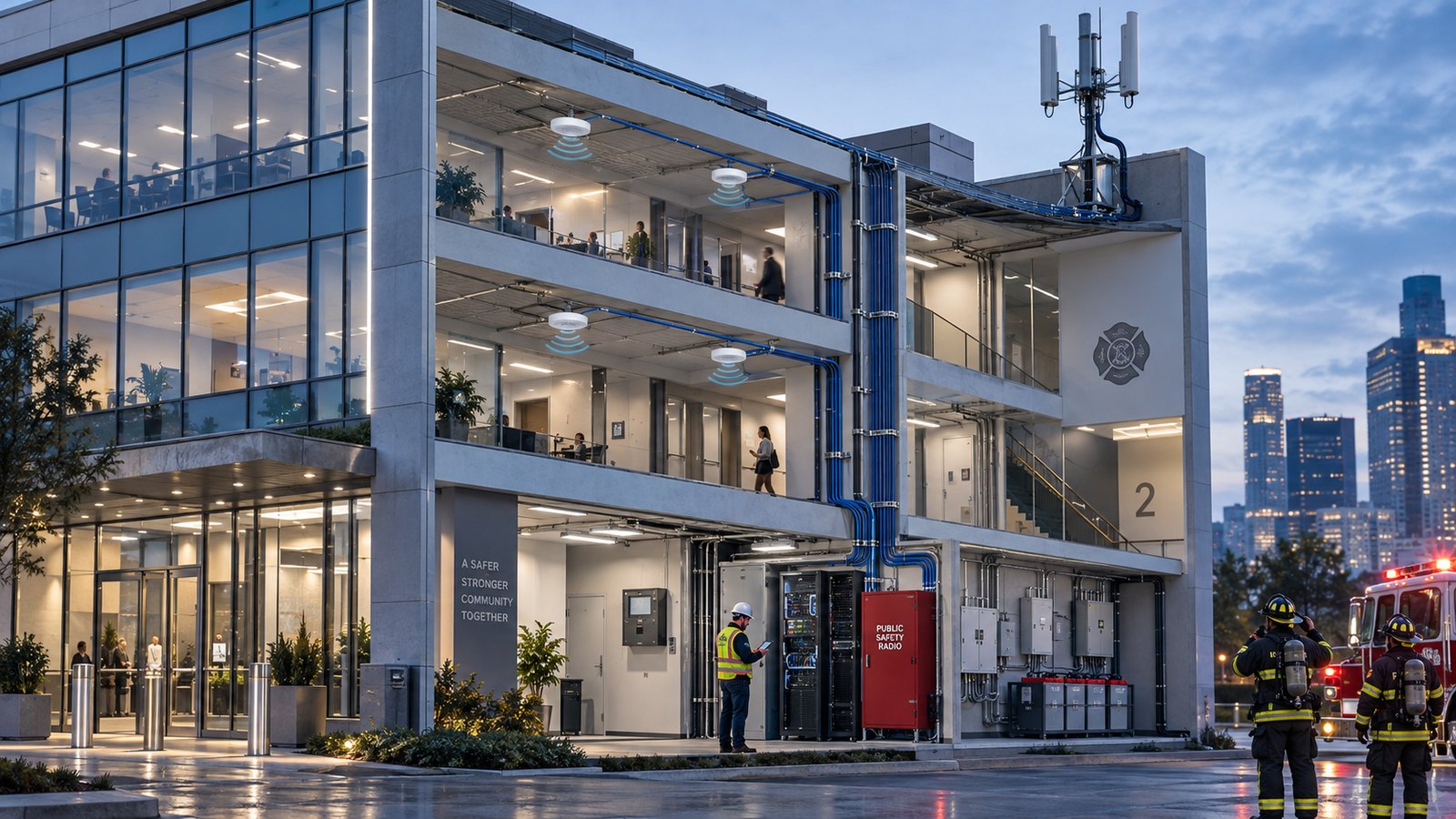


A building can pass every major inspection yet still fail to receive a certificate of occupancy if first responders cannot maintain reliable radio communications inside. Dense concrete, low-E glass, steel framing, and below-grade spaces can weaken or block the signals firefighters, police, and EMS personnel depend on during an emergency. NFPA 1225 establishes technical requirements that help address those coverage gaps.
Understanding what NFPA 1225 requires, who it applies to, and when compliance is triggered helps building owners, designers, and project teams plan for ERCES compliance before permitting, construction, and final inspections. This guide focuses on the requirements, testing, documentation, and compliance steps project teams need to understand.
Quick Overview of NFPA 1225 Requirements
| Requirement | Why It Matters |
|---|---|
| Radio coverage (95%/99%) | Helps ensure reliable emergency responder communications throughout the building. |
| Critical area coverage | Provides enhanced coverage in stairwells, fire command centers, and other designated life-safety spaces. |
| Signal enhancement (ERCES/BDA) | Restores coverage where natural signal penetration does not meet required performance levels. |
| Backup power | Maintains system operation during utility power failures. |
| Monitoring and alarms | Detects equipment or power faults before they affect system availability. |
| Acceptance testing | Confirms the installed system meets required performance criteria before occupancy. |
| Annual testing | Verifies continued compliance as building conditions change over time. |
| Documentation | Demonstrates compliance during inspections, future renovations, and ongoing maintenance. |
| Ongoing maintenance | Preserves long-term system performance and operational reliability. |
What Is NFPA 1225?
NFPA 1225, Standard for Emergency Services Communications, establishes the requirements for designing, installing, testing, and maintaining Emergency Responder Communication Enhancement Systems (ERCES), which are in-building radio systems that enable firefighters, law enforcement, and EMS personnel to communicate using their existing two-way radios throughout a structure.
It establishes performance criteria for reliable public safety radio coverage, including signal strength, delivered audio quality, backup power, system supervision, acceptance testing, and ongoing maintenance. It also affects the parties involved in delivering a code-compliant building, including owners, developers, architects, electrical and fire protection engineers, general contractors, and ERCES installers.
Rather than prescribing a one-size-fits-all system design, NFPA 1225 establishes performance and testing criteria an ERCES must meet. The specific solution, whether it involves a bi-directional amplifier (BDA), a distributed antenna system (DAS), or other approved components, depends on the building’s construction, existing radio coverage, and the requirements of the Authority Having Jurisdiction (AHJ).
For background on the systems themselves, see what an ERCES is and how it differs from cellular DAS.
Where NFPA 1225 Came From
NFPA 1225 combined and replaced the standalone NFPA 1061 and NFPA 1221 standards, bringing their emergency services communications requirements into a single, consolidated standard. NFPA 72 remains a separate, active standard and continues to address fire alarm and signaling systems.
For a detailed explanation of the NFPA 1061, NFPA 1221, and NFPA 1225 transition and what changed, see Understanding NFPA 1225: What’s Changed and Why It Matters.
Who Must Comply with NFPA 1225 Requirements?
Compliance depends on whether the local jurisdiction has adopted NFPA 1225 (directly or through the International Fire Code) and whether the Authority Having Jurisdiction (AHJ) requires an ERCES for a given building. There is no nationwide mandate requiring every commercial building to install an ERCES. Instead, compliance is determined on a project-by-project basis, often through local fire code adoption, plan review, and in-building radio coverage testing.
Buildings Commonly Evaluated for ERCES Requirements
- Commercial office buildings and high-rises
- Healthcare facilities
- Warehouses and distribution centers
- Hotels
- Schools and universities
- Airports
- Manufacturing facilities
- Government buildings
- Stadiums and arenas
When the Requirements Are Commonly Considered
- New construction
- Major renovations or building additions
- Changes in occupancy classification
- Failed in-building radio coverage testing
- Local fire code provisions requiring an ERCES review
In most cases, the AHJ, typically the local fire marshal or building official, determines whether an ERCES is required after reviewing applicable codes and evaluating the building’s radio coverage. Two buildings with similar occupancy or size may have different compliance requirements based on local code adoption, construction materials, and measured public safety radio coverage.
When Do NFPA 1225 Requirements Apply?
Many projects first encounter these requirements during permitting or final inspections. A building may satisfy architectural, structural, and fire protection requirements yet still require an ERCES if public safety radio coverage falls below the performance levels established by the applicable code.
Identifying potential coverage issues early allows project teams to coordinate design, permitting, and installation before they become costly schedule impacts.
Understanding the Core NFPA 1225 Requirements
Radio Signal Coverage
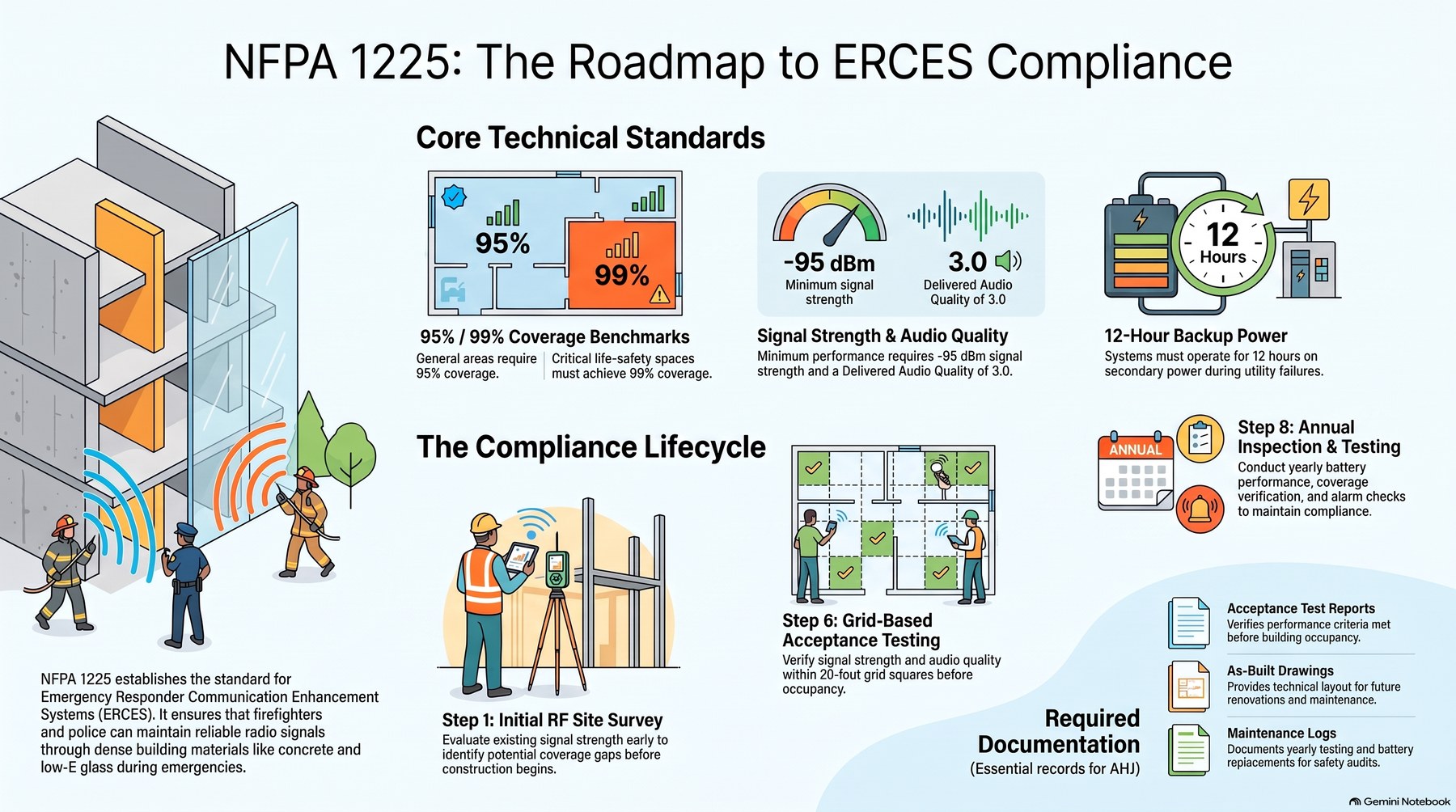
Rather than prescribing a specific manufacturer or system architecture, NFPA 1225 establishes minimum in-building radio performance requirements. The commonly referenced benchmark is an inbound signal strength of approximately -95 dBm with a Delivered Audio Quality (DAQ) of 3.0 or better, meaning voice communications remain understandable under normal operating conditions.
Coverage is generally evaluated against two performance thresholds:
- General building areas: 95% floor-area coverage
- Critical areas: 99% floor-area coverage
These performance targets help ensure emergency responders can communicate reliably as they move throughout the building, including locations where construction materials often reduce RF signal penetration.
Coverage Areas Required Under NFPA 1225
Critical areas receive the highest level of coverage because communication failures in these locations can directly affect emergency operations. Depending on the building type and AHJ requirements, these areas commonly include:
- Stairwells and exit passageways
- Elevators and elevator lobbies
- Fire command centers
- Fire pump rooms
- Standpipe cabinets
- Sprinkler sectional valve locations
- Basements
- Parking garages
- Other spaces designated by the AHJ
In hospitals, high-rises, warehouses, and other complex facilities, maintaining reliable radio communications in these critical areas supports coordinated emergency response.
When Is an ERCES or BDA Required?
Not every building requires an ERCES. The need for signal enhancement is typically determined after radio coverage testing shows the building cannot meet the required performance thresholds using outdoor public safety radio signals alone.
Buildings constructed with reinforced concrete, structural steel, low-E glass, extensive below-grade areas, or large interior footprints frequently experience radio dead zones that require signal enhancement. In these situations, an Emergency Responder Communication Enhancement System (ERCES), often incorporating a bi-directional amplifier (BDA) and a distributed antenna system, helps restore compliant radio coverage throughout the building.
Before installation, the system design is typically reviewed and approved by the AHJ to verify it satisfies applicable code requirements and local public safety radio system criteria. Learn more about the differences between ERCES, BDA, and DAS.
Backup Power Requirements
Because emergency communications must remain available during power outages, NFPA 1225 requires ERCES installations to include reliable secondary power.
Secondary power helps keep the system operational until utility power is restored. A commonly applied benchmark is 12 hours of operational battery capacity, with supervisory monitoring extending to 24 hours.
Backup power helps ensure emergency responder communications remain available during commercial power outages, reducing the risk of communication failures during critical incidents. Learn more about backup power options for ERCES.
Monitoring and Alarm Requirements
NFPA 1225 requires continuous supervision of critical ERCES components so faults can be identified before they compromise system performance.
Supervisory signals monitor equipment failures, power supply issues, and other system faults that could affect ERCES performance. These signals are typically annunciated through the building’s fire alarm system, with a dedicated annunciator located at the fire command center or another continuously attended location, displaying the operational status of RF-emitting equipment and other active system components.
Early fault notification allows facility teams to identify and resolve issues before they affect emergency responder communications or compliance inspections.
Equipment Installation and Protection
An ERCES is expected to perform reliably under demanding conditions, making proper equipment installation as important as system design.
Equipment is typically housed in enclosures appropriate for the installation environment, often NEMA 4 or NEMA 4X rated where conditions warrant. Critical infrastructure, including backbone cabling, riser coaxial cable, and power circuits, must be protected using approved fire-resistive methods, such as 2-hour fire-rated cable assemblies, where required by the applicable code.
Equipment locations should remain accessible for inspection, testing, preventive maintenance, and future repairs. Coordinating these installation requirements during design helps reduce construction conflicts and simplifies long-term maintenance.
NFPA 1225 Testing Requirements Explained
Acceptance Testing
Before an ERCES is placed into service, acceptance testing verifies that the installed system meets the required radio coverage and performance criteria.
Testing is typically performed using a grid-based methodology, with the building divided into 20-foot (or smaller) grid squares. Each grid is evaluated for both signal strength and Delivered Audio Quality (DAQ) to verify compliance with the applicable coverage requirements. While a limited number of isolated, non-adjacent grid failures may be permitted under the standard, clusters of failed grids generally require system adjustments and re-testing.
Depending on local procedures, the AHJ may witness the acceptance test or review the completed test documentation before approving the installation.
Annual Inspection and Testing
Compliance continues after occupancy. NFPA 1225 requires periodic testing to verify that the ERCES continues to perform as intended as the building and its RF environment change over time. Annual testing typically includes:
- Coverage verification
- Battery performance testing
- Alarm and supervisory function testing
- Inspection of active system components
- General operational checks
These inspections help identify issues such as equipment failures, battery degradation, or changes in RF performance before they affect emergency communications. They also support ongoing compliance with IFC Section 510.6.1, which generally requires ERCES testing at least once every 12 months, with results submitted to the AHJ where required.
Re-Testing After Building Modifications
Radio frequency performance can change long after the original installation. Renovations, tenant improvements, new partitions, equipment additions, or structural modifications may alter signal propagation enough to affect system performance.
When these changes have the potential to impact radio coverage, additional testing is often required to verify the building continues to meet the applicable coverage criteria. Identifying these impacts during project planning is typically far less disruptive than discovering them during a post-construction inspection.
Documentation Required by NFPA 1225
Comprehensive documentation demonstrates ongoing compliance and supports future inspections, renovations, troubleshooting, and system maintenance. AHJs typically require documentation showing how the system was designed, tested, approved, and maintained throughout its service life.
Documentation Commonly Includes
- Acceptance test reports
- RF survey results
- As-built drawings
- Equipment lists
- Battery capacity calculations
- Inspection records
- Maintenance logs
- AHJ approvals or acceptance documentation
Ongoing Maintenance Responsibilities
- Scheduled inspections
- Preventive maintenance
- Battery replacement at recommended intervals
- Firmware or software updates, where applicable
- Repair of failed or degraded components
- Documentation of all maintenance activities
Maintaining complete, well-organized records simplifies future inspections, renovations, troubleshooting, insurance reviews, tenant improvements, and system upgrades while demonstrating ongoing compliance throughout the system’s lifecycle.
Maintenance Requirements for Ongoing Compliance
Like other critical life-safety systems, an ERCES requires routine maintenance to preserve performance, improve reliability, and reduce the risk of unexpected failures during an emergency.
A structured maintenance program supports code compliance, extends equipment life, and simplifies future inspections and acceptance testing after building modifications.
Who Enforces NFPA 1225 Requirements?
NFPA 1225 is enforced by the Authority Having Jurisdiction (AHJ), which is typically the local fire marshal, building department, or another designated code official.
Enforcement depends on the codes adopted within the jurisdiction. Many states and municipalities reference NFPA 1225 through the International Fire Code, while others may adopt different editions or local amendments. As a result, compliance requirements can vary between jurisdictions.
Before designing, installing, or modifying an ERCES, project teams should confirm which code edition applies and coordinate with the AHJ early in the design process. Early coordination often prevents redesigns, permitting delays, and unexpected field changes later in construction.
Common NFPA 1225 Compliance Challenges
Several factors can make achieving compliant in-building radio coverage more challenging, including:
- Existing buildings with poor native radio coverage
- Reinforced concrete, structural steel, or low-E glass construction
- Large warehouses and multi-building campuses
- Healthcare facilities with complex layouts and critical spaces
- Historic buildings with retrofit limitations
- Coordinating ERCES design among owners, design teams, contractors, wireless stakeholders, and the AHJ
- Local amendments that modify testing procedures or coverage requirements
Many of these challenges can be identified through an RF site survey during the design phase. Addressing coverage issues early gives project teams more flexibility and is typically more efficient than redesigning or retrofitting a system after a failed inspection.
Common Mistakes That Can Delay Compliance
Several avoidable issues can delay approvals or require costly corrective work:
- Waiting until final inspection to test radio coverage
- Assuming a cellular DAS satisfies ERCES requirements (see ERCES vs. DAS)
- Submitting incomplete testing or design documentation
- Missing required annual inspections and testing
- Delaying coordination with the AHJ
- Failing to re-test after renovations or significant building modifications
Incorporating RF testing and AHJ coordination early in the project helps minimize schedule impacts and reduce the likelihood of unexpected change orders.
How To Achieve NFPA 1225 Compliance
Although every project follows its own approval process, the path to compliance generally includes these steps:
Conduct an RF site survey
Perform baseline in-building radio coverage testing
Determine whether an ERCES is required
Design the system to meet applicable coverage, power, and supervision requirements
Coordinate the design with the AHJ before installation
Install the ERCES
Complete acceptance testing
Assemble and retain all required documentation
Schedule ongoing inspections, testing, and preventive maintenance
Approaching compliance as a lifecycle process, rather than simply an installation milestone, helps building owners maintain reliable emergency responder communications long after the project is complete.
Ready to Get Started?
Complete the form to request a consultation. Our team will review the information, and a personal manager will reach out to you.
Frequently Asked Questions
What are the main requirements of NFPA 1225?
NFPA 1225 establishes requirements for reliable in-building public safety radio communications, including minimum radio coverage, signal strength, delivered audio quality, backup power, system supervision, acceptance testing, documentation, and ongoing inspection and maintenance. The commonly referenced coverage benchmarks are 95% in general areas and 99% in designated critical areas.
Does every commercial building need an ERCES?
No. An ERCES is not automatically required for every commercial building. Requirements depend on the codes adopted by the local jurisdiction, the results of in-building radio coverage testing, and the determination of the Authority Having Jurisdiction (AHJ).
When is an ERCES required under NFPA 1225?
An ERCES is typically required when testing shows a building cannot achieve the required public safety radio coverage using existing outdoor signals alone. Construction materials, building size, below-grade spaces, and overall building configuration frequently influence whether signal enhancement is necessary.
What happens if a building fails its radio coverage test?
If a building doesn’t meet the required in-building public safety radio coverage, the AHJ may require an ERCES before approving occupancy or continued compliance. The next steps typically include an RF site survey, system design, installation, acceptance testing, and final approval. Requirements vary by jurisdiction.
Does NFPA 1225 require annual testing?
Yes. NFPA 1225 requires periodic inspection and annual testing to verify the ERCES continues to operate as intended. Testing typically includes coverage verification, battery performance, supervisory functions, and equipment inspection in accordance with the applicable code requirements.
What documentation is required for compliance?
Typical documentation includes acceptance test reports, RF survey data, as-built drawings, equipment inventories, battery calculations, inspection records, maintenance logs, and documentation requested by the AHJ. Maintaining complete records simplifies future inspections, renovations, and system upgrades.
How does NFPA 1225 work with the International Fire Code?
The International Fire Code (IFC) Section 510 generally establishes when in-building emergency responder radio coverage is required, while NFPA 1225 provides the technical requirements for designing, installing, testing, inspecting, and maintaining the ERCES used to achieve that coverage. Together, these documents form the framework many jurisdictions use for evaluating compliance.
Building a Long-Term Strategy for NFPA 1225 Compliance
Meeting NFPA 1225 requirements involves more than installing an ERCES after a failed radio coverage test. The most successful projects address emergency responder communications early during planning and design, when RF surveys, system coordination, and AHJ review can be integrated into the broader construction schedule instead of becoming last-minute obstacles.
For building owners, developers, architects, engineers, contractors, and facility managers, early planning helps reduce permitting delays, avoid costly retrofits, and support reliable emergency communications throughout the life of the building. Ongoing inspections, testing, and preventive maintenance help keep the ERCES compliant as the building evolves over time.
If you’re planning a new construction project, renovating an existing facility, or preparing for an AHJ review, DAS Systems can help. Our team provides ERCES design, RF site surveys, acceptance testing, commissioning support, and ongoing maintenance to help you achieve reliable, code-compliant emergency responder communications. Contact DAS Systems today to discuss your project and determine the most effective path to NFPA 1225 compliance.