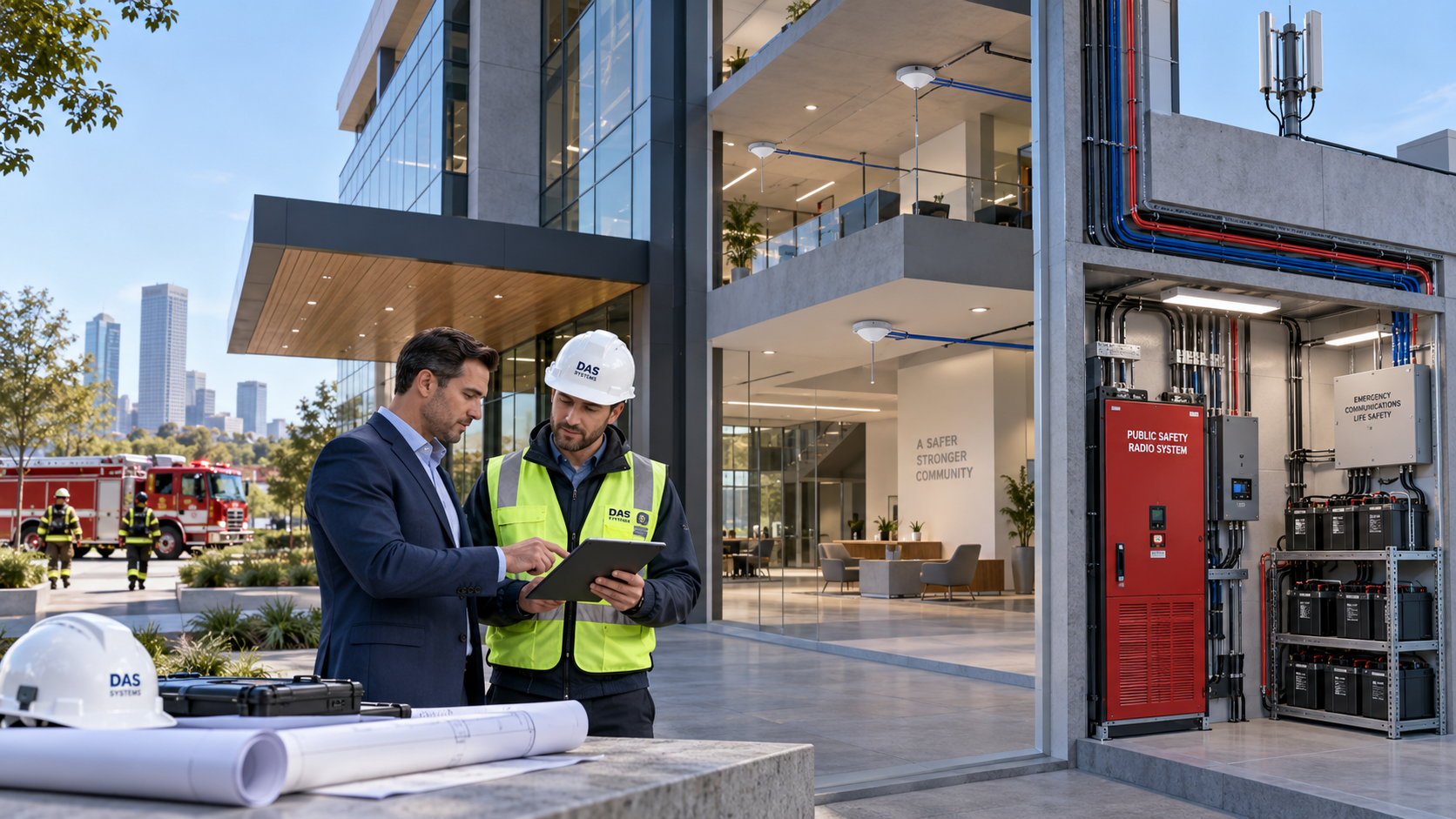


A failed radio coverage test late in construction can delay occupancy, trigger unexpected system upgrades, and create costs that were never included in the original budget. For building owners, developers, and contractors, the biggest ERRCS expense is not always the system itself. In many projects, the greater financial risk comes from planning too late.
Building owners researching ERRCS compliance services cost should consider more than the initial installation price, particularly when late planning can lead to retrofit work, additional testing, and project delays.
Early ERRCS planning allows project teams to identify radio coverage requirements, coordinate system infrastructure with the building design, and address potential deficiencies before walls, ceilings, and other finishes are complete.
For a detailed breakdown of the factors that influence ERRCS pricing, see our ERRCS installation cost guide.
Why Delaying ERRCS Planning Can Increase Project Costs
An Emergency Responder Radio Communication System (ERRCS), also known as an Emergency Responder Communication Enhancement System (ERCES), is designed to maintain reliable communications for firefighters, law enforcement, and EMS personnel throughout a structure.
Modern construction materials such as reinforced concrete, low-E glass, and metal decking can weaken outdoor radio signals before they reach stairwells, basements, corridors, and other interior spaces. International Fire Code (IFC) Section 510 establishes requirements for approved in-building emergency responder radio coverage in qualifying buildings, although adopted code editions, local amendments, and enforcement requirements vary by jurisdiction.
The financial problem arises when these requirements are identified late in the construction process.
If an RF survey or coverage evaluation reveals inadequate signal levels after construction is substantially complete, the project may need additional cabling, antennas, amplifiers, pathways, or other infrastructure. Installing those components after finishes are in place can require additional labor and coordination.
Late planning can also create:
- Change orders that were not included in the original construction budget
- Additional coordination between electrical, fire alarm, low-voltage, and other trades
- Work around completed ceilings, walls, and occupied areas
- Additional testing and corrective work
- Delays to final acceptance or occupancy if required coverage levels are not achieved
The earlier ERRCS requirements are evaluated, the more opportunities the project team has to incorporate the system into the building rather than retrofit it later.
Retrofit vs. New Construction: Where Timing Makes a Difference
The difference between planning ERRCS during new construction and adding it to a completed building is not simply a matter of equipment cost. Construction access, infrastructure pathways, labor, and coordination can all affect the final project expense.
New Construction Allows ERRCS Infrastructure to Be Coordinated Early
During the design and construction phases, project teams can account for:
- Conduit and cable pathways
- Equipment room requirements
- Power and backup power
- Rooftop donor antenna locations
- Antenna locations and coverage zones
- Coordination with electrical and fire alarm systems
- Access for future inspection and maintenance
Addressing these requirements before construction advances can reduce the need to modify finished areas later. Early coordination can also help the ERRCS design align with architectural and MEP plans rather than forcing the system to fit around completed construction.
Retrofit Projects Can Introduce Additional Costs
- Access above finished ceilings
- Penetration through existing structures
- New pathways through completed areas
- Work around occupied spaces
The exact impact depends on the building and its existing infrastructure, so there is no universal percentage or dollar figure that applies to every retrofit.
The Cost of ERRCS Doesn’t End at Installation
Another budgeting mistake is treating ERRCS as a one-time construction expense.
In many jurisdictions, ongoing inspection, testing, and recertification are part of maintaining compliance throughout the life of the system. IFC Section 510 requirements and local AHJ procedures can require periodic testing, with additional testing potentially required after structural or occupancy changes that could affect radio performance.
Annual Inspections May Include
- Verification of radio coverage using calibrated test equipment
- Battery backup testing
- Review of system performance
- Documentation of test results
- Submission of required records to the local fire authority
Renovations Can Create Additional Testing Requirements
- ERRCS coverage can change when a building’s interior configuration changes
- Adding walls, modifying tenant spaces, changing layouts, or making other structural alterations can affect RF propagation
- A system that passed acceptance testing before a renovation may require additional evaluation afterward
These recurring requirements should be considered when developing the building’s long-term operating budget. Planning for these potential costs helps building owners avoid discovering compliance issues during a later inspection or tenant improvement project.
ERRCS vs. Cellular DAS: Why the Cost Structures Differ
Property owners sometimes assume an ERRCS and a commercial cellular DAS are essentially the same system because both distribute radio signals inside buildings. They are not interchangeable.
A cellular DAS improves mobile coverage for tenants, employees, and visitors using commercial carrier networks. An ERRCS, by contrast, supports emergency responder communications on licensed public safety frequencies. That difference in purpose creates different design, compliance, testing, and operating requirements.
An ERRCS May Involve Requirements Associated With
- FCC Part 90
- UL 2524-listed equipment
- Emergency responder radio coverage
- Battery backup
- Acceptance testing
- AHJ review
- Recurring inspection and testing
A Commercial Cellular DAS
- Is designed around carrier networks and commercial wireless coverage
- Serves tenants, employees, and visitors rather than emergency responders
- Is not built around the life-safety requirements governing an ERRCS
Some projects may ultimately require both systems. In certain circumstances, shared infrastructure such as fiber backbone or antenna pathways may be possible, but that approach requires careful RF analysis to confirm that it will not compromise public safety performance or applicable code requirements.
What Building Owners Can Do to Avoid Unexpected ERRCS Costs
The most effective way to control avoidable ERRCS expenses is to address the system before construction decisions become difficult or expensive to change.
Conduct an RF Survey Early
A professional RF survey establishes actual radio conditions rather than relying on assumptions about whether a building will require an ERRCS or what type of system it may need.
Testing existing signal levels can identify coverage deficiencies before construction is complete and provide the information needed for system design.
Confirm Local AHJ Requirements
ERRCS requirements can vary according to the jurisdiction, adopted fire code edition, local amendments, and Authority Having Jurisdiction (AHJ) procedures.
Confirming the applicable requirements early can help prevent design changes later in the project.
Coordinate ERRCS With the Building Design
ERRCS pathways, equipment locations, power requirements, donor antenna locations, and other infrastructure should be coordinated with the architectural, electrical, fire protection, and low-voltage design.
Early coordination can reduce conflicts and make installation more efficient.
Budget for Testing and Ongoing Compliance
The initial installation is only one part of the ERRCS lifecycle. Owners should also account for inspection, testing, recertification, maintenance, and potential retesting after future building modifications.
Including these expenses in the operating budget can reduce the likelihood of unexpected compliance costs.
The Codes Behind ERRCS Compliance
ERRCS compliance costs are driven by more than equipment and installation. They reflect the engineering, documentation, testing, and verification required to satisfy applicable fire and communications standards. Understanding these requirements helps explain why simply adding a few antennas rarely meets code or passes acceptance testing.
IFC Section 510
International Fire Code (IFC) Section 510 establishes requirements for approved in-building emergency responder radio coverage in qualifying buildings. Adopted code editions and local amendments vary by jurisdiction.
Many adopted requirements address periodic testing and re-testing following changes that could affect radio performance. Jurisdictions may also establish minimum coverage requirements for general and critical areas.
Delivered Audio Quality (DAQ)
Delivered Audio Quality (DAQ) is a metric used to evaluate how clearly speech can be understood over a radio system. NFPA technical material identifies DAQ as one of the metrics that may be used when evaluating ERRCS performance, with testing procedures and pass/fail criteria determined by the applicable standard and Authority Having Jurisdiction (AHJ).
Including audio-quality evaluation where required or specified helps verify that an ERRCS provides usable voice communications rather than relying solely on measured radio signal strength. The applicable testing method and DAQ requirements should be confirmed with the AHJ for the project.
NFPA 1225
NFPA 1225 is the current national standard governing emergency services communications, replacing requirements previously distributed across NFPA 72 and NFPA 1221.
It addresses system design, installation, testing, inspection, maintenance, and pathway survivability. These requirements help ensure that system infrastructure remains capable of supporting emergency communications during a fire event.
UL 2524
Bi-directional amplifiers (BDAs) and other components used in a compliant system should carry the applicable UL 2524 listing for in-building two-way emergency radio communication enhancement systems.
AHJs may verify equipment compliance during acceptance testing. Selecting appropriate listed equipment is therefore an important part of avoiding corrective work and approval delays.
FCC Part 90
Because an ERRCS retransmits licensed public safety radio signals, its operation is subject to applicable FCC Part 90 requirements.
Class B signal boosters must be registered with the FCC, and applicable public safety licensee consent requirements must be satisfied before signals are retransmitted. Overlooking these requirements can create approval and compliance problems that add avoidable project costs.
Together, these requirements explain why ERRCS planning involves more than purchasing equipment. Engineering, coordination, documentation, testing, and ongoing compliance all need to be considered throughout the system’s lifecycle.
Getting an Accurate ERRCS Cost Estimate
There is no reliable way to determine the appropriate ERRCS budget from building size alone.
A professional RF survey and engineered system design provide the information needed to evaluate the building’s actual radio conditions and applicable requirements.
Assess the Building
- Measure existing public safety radio signal levels
- Identify the frequency bands used by the applicable public safety agencies
- Evaluate building construction and potential RF attenuation
- Determine whether an ERRCS is required
Design and Coordinate
- Develop a system design based on verified coverage requirements
- Identify infrastructure and equipment requirements
- Coordinate with the project team and AHJ
- Establish the testing and commissioning requirements
This process helps avoid two expensive outcomes: overdesigning a system that is more extensive than necessary or installing an undersized system that fails acceptance testing and requires corrective work.
DAS Systems partners with building owners, developers, architects, engineers, and general contractors to design, install, test, and maintain code-compliant ERCES solutions, from the initial RF survey through commissioning and ongoing compliance.
You can review examples of completed projects on our case studies page or learn more about system fundamentals through our ERCES overview.
Ready to Get Started?
Complete the form to request a consultation. Our team will review the information, and a personal manager will reach out to you.
Frequently Asked Questions
Can I get a fixed price without a site visit?
A reliable project-specific proposal generally requires an RF survey and evaluation of the building.
Construction, layout, materials, existing radio signal strength, frequency bands, and applicable AHJ requirements can all affect system design. Estimating those conditions without field data can result in an undersized system that requires corrective work before acceptance.
Does a small building still need an ERRCS?
It depends on the jurisdiction.
Applicable fire codes may establish building size, height, occupancy, or other criteria that trigger evaluation for emergency responder radio coverage. Local amendments and AHJ requirements can also affect when an ERRCS is required.
Building owners should confirm the applicable requirements with the local AHJ rather than relying on a universal building-size threshold.
Who pays for ERRCS upgrades if radio frequencies change?
Responsibility can depend on the applicable code, licensing requirements, system ownership, and local jurisdiction.
Changes to public safety radio networks or FCC licensing can affect an existing ERRCS after installation. Building owners should therefore account for ongoing system evaluation and maintenance when planning long-term compliance costs.
Is ERRCS the same thing as a fire alarm system?
No.
An ERRCS is a public safety radio communication enhancement system regulated under applicable fire code requirements and FCC Part 90. It operates independently from the building’s fire alarm system, although the two systems may be interconnected for supervisory monitoring where required by the adopted codes and AHJ.
Plan ERRCS Before It Becomes a Project Delay
The most expensive ERRCS problem is often the one discovered after construction is nearly complete.
Waiting until final testing to determine whether a building meets emergency responder radio coverage requirements can leave project teams with fewer options, less access to infrastructure, and greater pressure to complete corrective work quickly.
Early RF testing, engineering, and AHJ coordination give building owners and project teams more opportunities to incorporate ERRCS requirements into the construction plan rather than retrofit them later.
For a detailed breakdown of ERRCS pricing factors, refer to our ERRCS installation cost guide. For projects where timing and compliance are the primary concern, an early RF assessment can help identify potential problems before they become expensive.
DAS Systems provides RF engineering, ERRCS design, installation, acceptance testing, commissioning, and ongoing inspection services for commercial buildings seeking reliable, code-compliant emergency responder communications.
Contact DAS Systems to schedule a site assessment and receive a project-specific evaluation based on your building’s RF conditions, applicable requirements, and long-term compliance needs.